
Deep Dive Report : Yaskawa Electric - A century of innovation in motion
AI gets physical : Why the Next Trillion-Dollar AI Company Will Build Robots, Not Chatbots. "This is for educational purposes only and do not constitute a financial advice or recommendations"

Conservative Strength, Radical Innovation: The 110-Year-Old Giant Building the Body for AI’s Brain
The year is 2030. Inside a “lights-out” factory, the sound of factory never ceases. There are no humans on the floor—only machines moving with a fluidity that was impossible just a decade ago. A robot arm doesn’t just blindly weld a seam : it feels a microscopic imperfection in the metal and adjusts its torque in milliseconds. Across the aisle, a logistics unit navigates a long path not because it was programmed to but because it saw an obstacle and reasoned a way around it.
You might expect the logo on these machines to belong to a Silicon Valley unicorn or a flashy new AI startup.
It doesn’t. The name stamped on the side of the machine powering this revolution is Yaskawa.
While the world was busy watching Generative AI write poetry and generate images, a quiet and old Japanese colossus was busy solving a much harder problem: teaching AI how to interact with the physical world. We are witnessing the end of the “Chatbot Era” and the dawn of Physical AI : Yaskawa Electric isn’t just participating. They have spent the last century building the very nervous system this new intelligence needs to survive.
Why Yaskawa is the Hidden Architect of the Physical AI Revolution
The limitation of modern AI is that it is a brain without a body. Large Language Models (LLMs) can process vast amounts of text but they cannot hold a screwdriver or feel the resistance of a bolt. For AI to truly revolutionize the economy and move from the digital screen to the factory floor then it needs a physical interface.
This is where Yaskawa’s conservative strategy reveals its radical brilliance.
For decades, Yaskawa has operated on a philosophy called i³-Mechatronics (integrated, intelligent, innovative). On the surface, this looked like traditional industrial efficiency: better motors, faster drives, stronger robots. But in reality, they were building a data-rich infrastructure. By embedding sensors and data collection into the very “cells” of the manufacturing floor, Yaskawa turned dumb machinery into a digital playground ready for AI integration.
They didn’t just build robots , I believe that they are building an “Intelligent Trinity” required for Physical AI:
The Eyes (Perception): Advanced vision systems that allow machines to see in 3D, not just 2D.
The Brain (Autonomy): With their new MOTOMAN NEXT series, they have moved beyond rigid coding to autonomous adaptation allowing robots to “reason” through unstructured tasks like handling variable food products or navigating messy warehouses.
The Hands (Action): Their legacy in servo motors gives them the “dexterous manipulation” capabilities and the ability to handle delicate items with a touch human hands would envy.
While startups struggle to build hardware that doesn’t break, Yaskawa has 110 years of reliability baked into their DNA. They are the invisible hand providing the unshakable foundation that Physical AI needs to scale from a science experiment to an industrial reality.
But having the technology is one thing , what about turning it into a profitable empire ? How does a company known for conservative Japanese management and strong standard can capture one of the most explosive growth markets in history?
Let’s look at their new product MOTOMAN to have an idea :
A little bit of history: A century of innovation
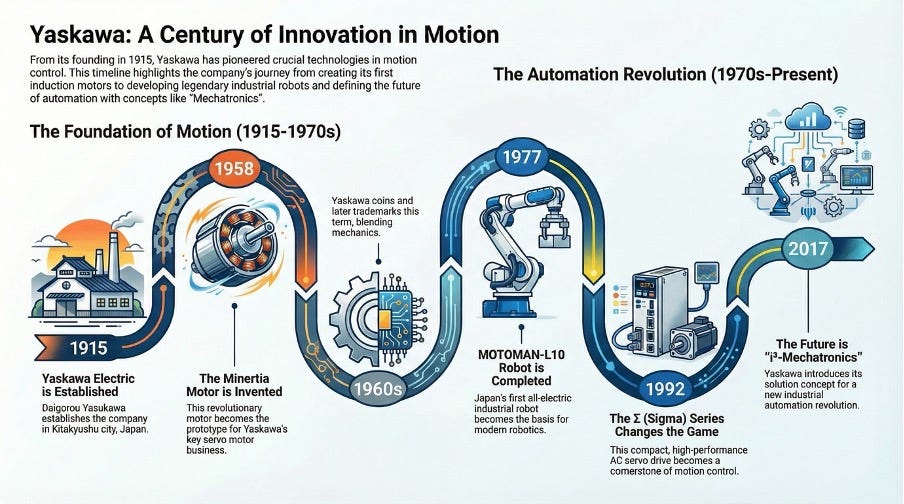
Established in 1915, Yaskawa Electric Corporation has always been a company that constantly evolved: from manufacturer of coal mining motors to being a global leader in industrial automation and mechatronics. Throughout their 110-year history, the company is known that adhere to strong philosophy of technology-driven innovation and they do not hesitate to shift their core identity from motors to solutions that drives modern manufacturing.
Early foundation: 1915- 1950s
Yaskawa was founded in Kitakyushu in 1915 by Daigoro Yasukawa, with a mission to “contribute broadly to social development and human welfare“ through business execution.
Foundation and the era of Motors: 1915 – 1950s
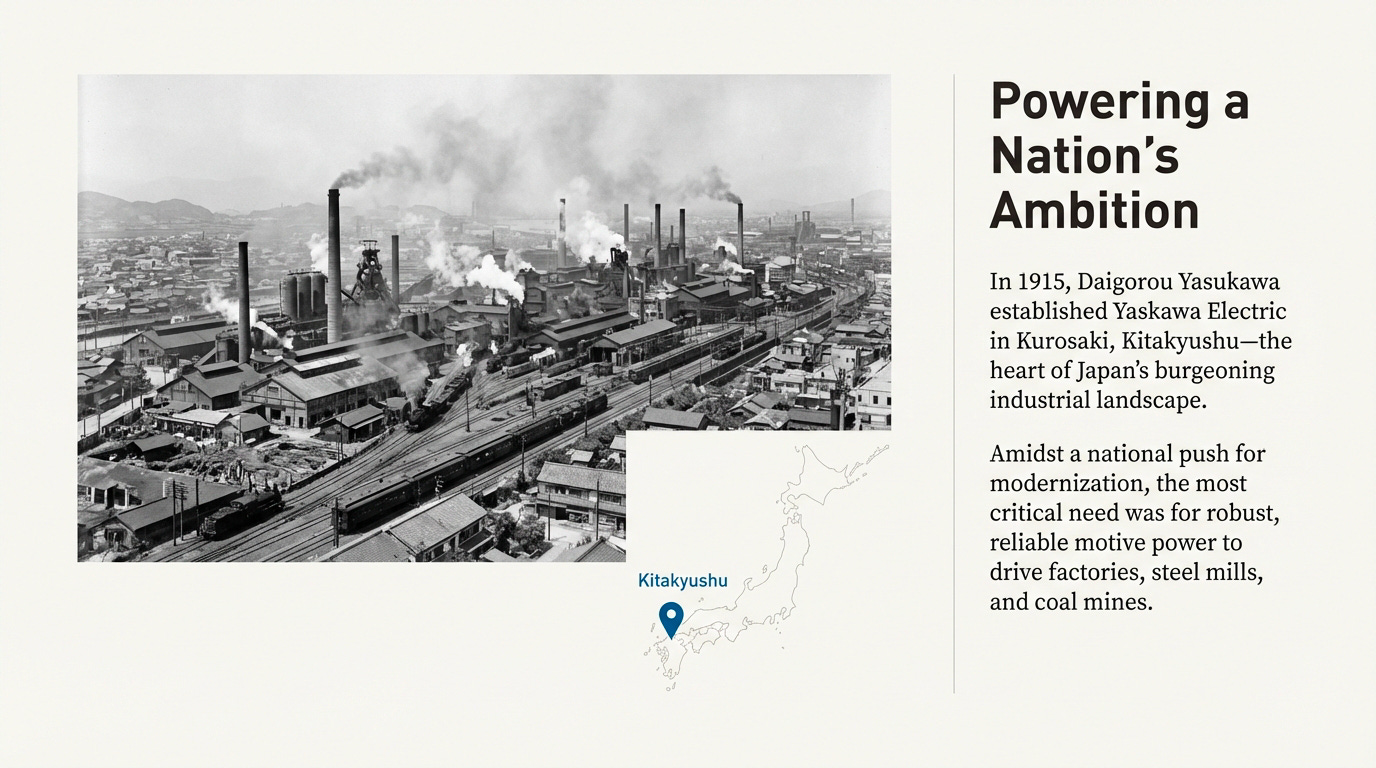
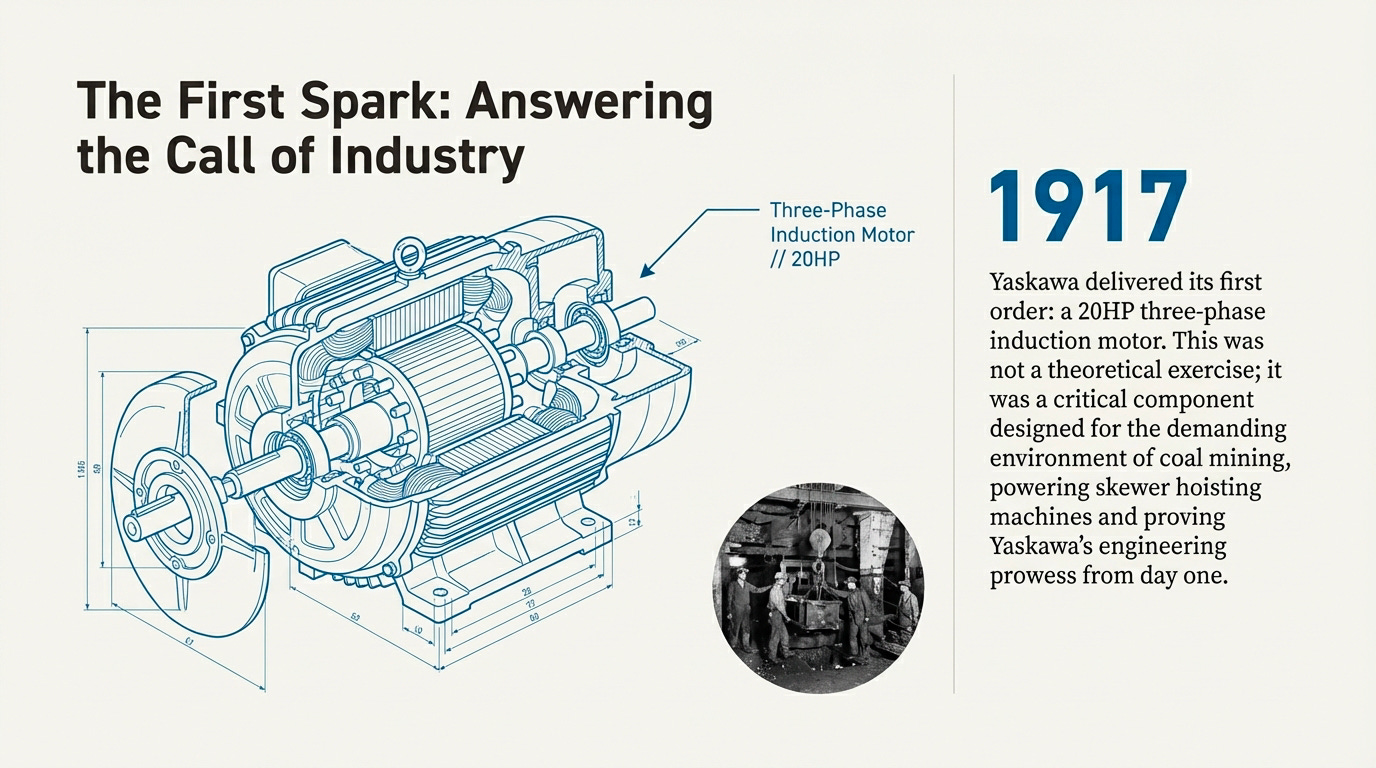
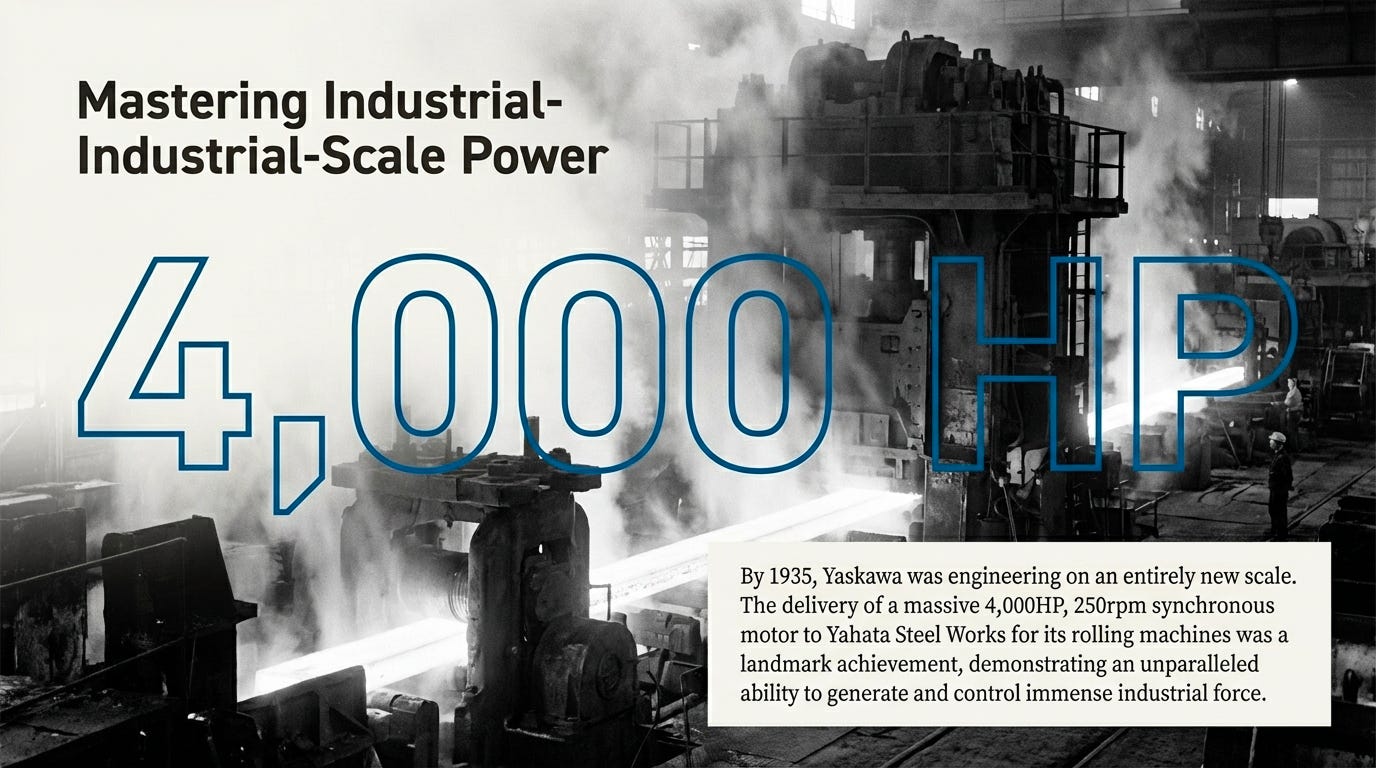
With the early industrialization , the company’s first order with was a 20 HP – three phase induction motor was delievered in 1917 for applications in coal mining. Thirteen years later, Yaskawa had established itself as a key supplier for Japan’s industrial base and delivered massive synchronous motors for steel rolling machines.
Post-war innovation
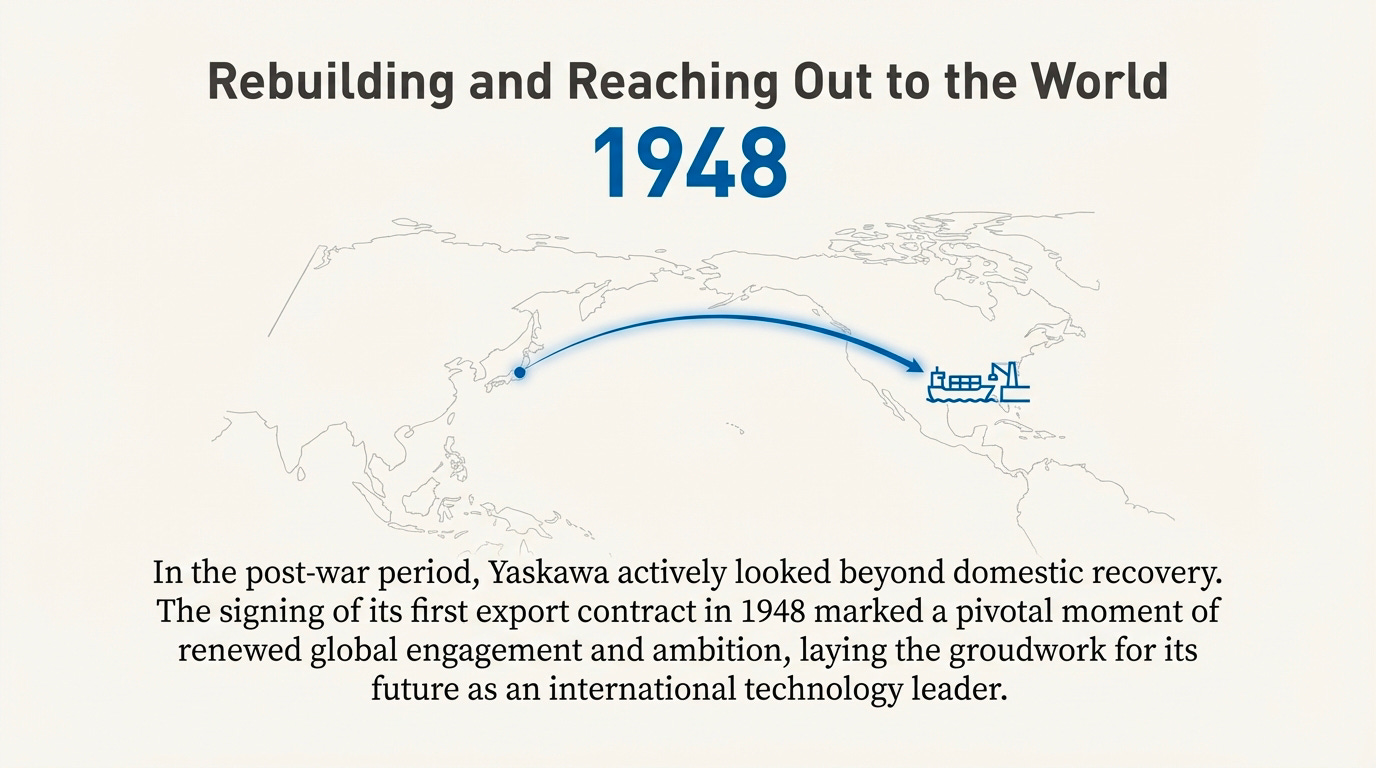
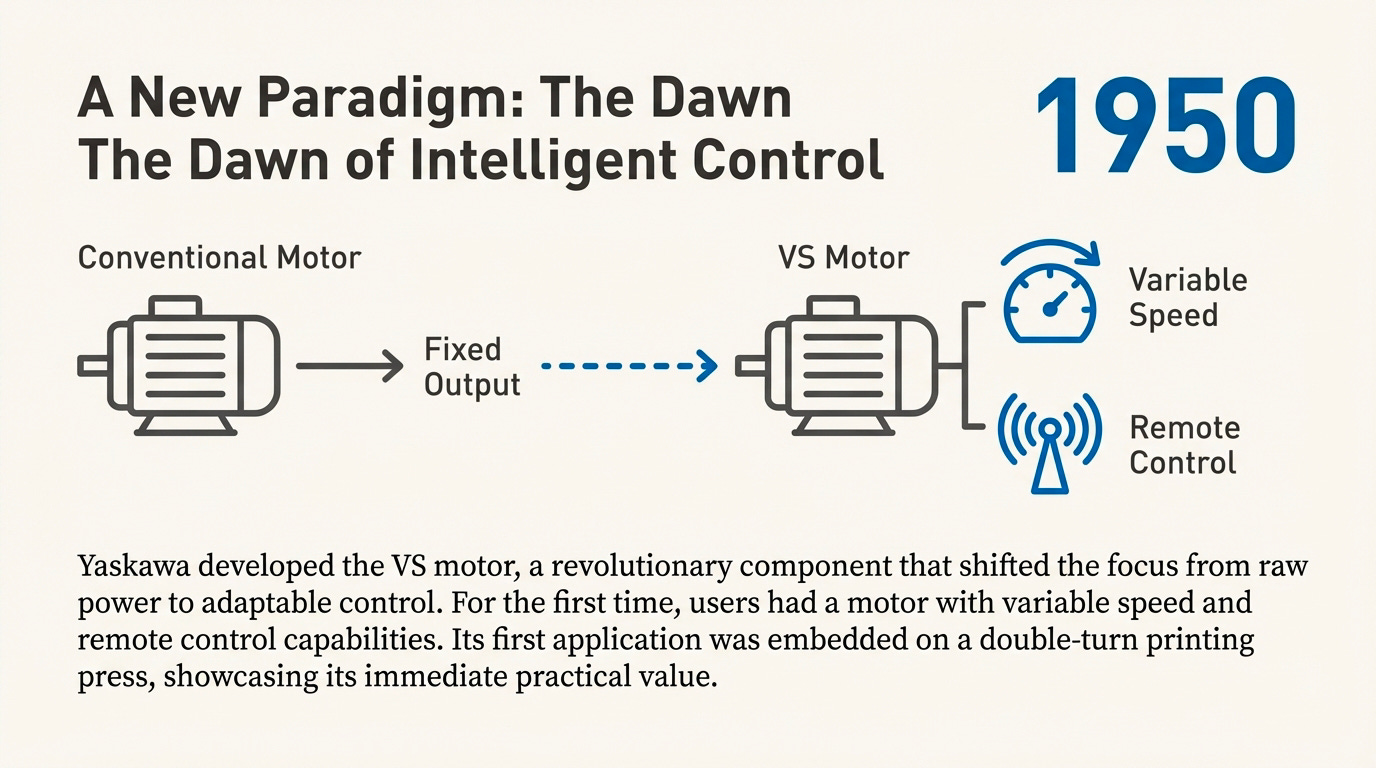
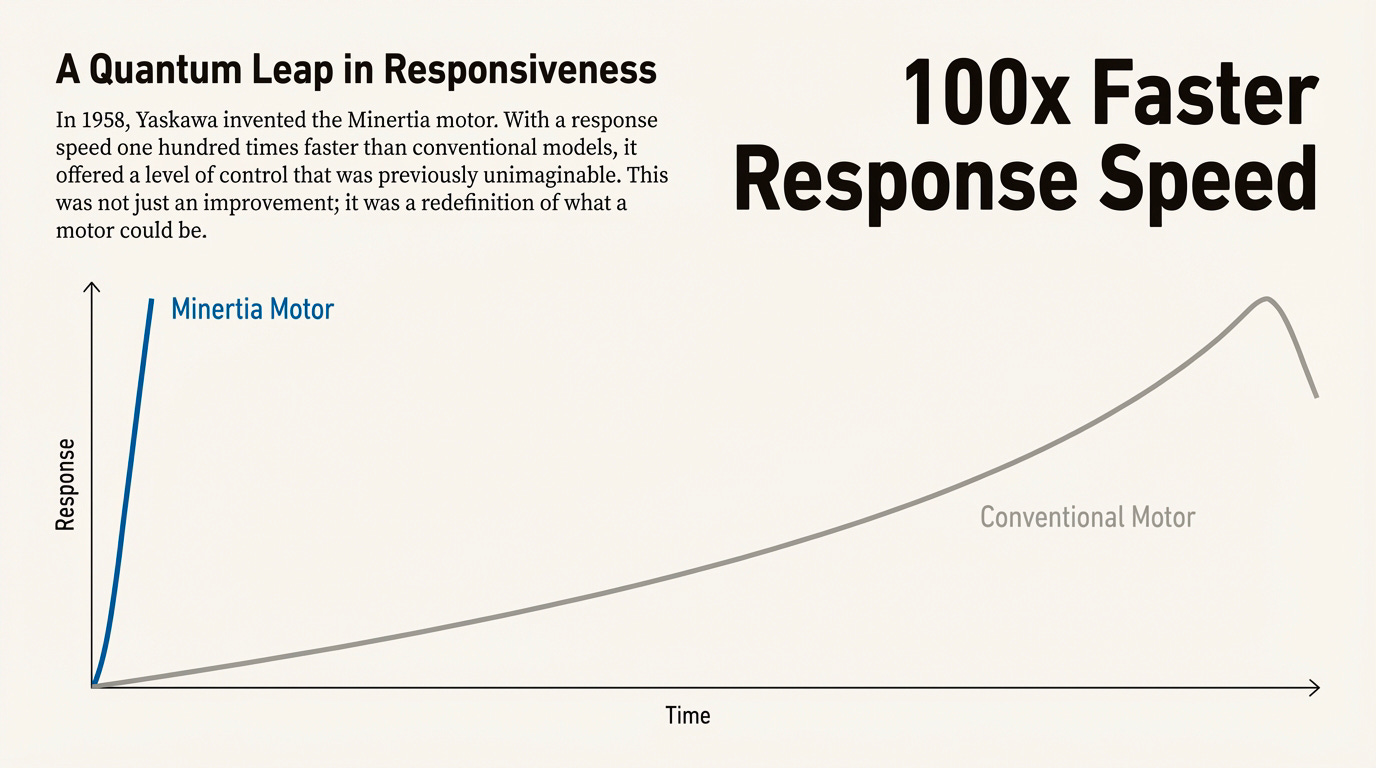
Following World War 2, Yaskawa actively pursued exports, signing its first export contract in 1948. The 1950s marked a period of rapid technological advancement with the invention of the “Minertia motor” in 1958. This revolutionary product offered response speeds 100 times faster than conventional models, serving as the prototype for the modern servo motor, which remains a key component of Yaskawa’s business today.
The birth of Mechatronics : 1960s- 1980s
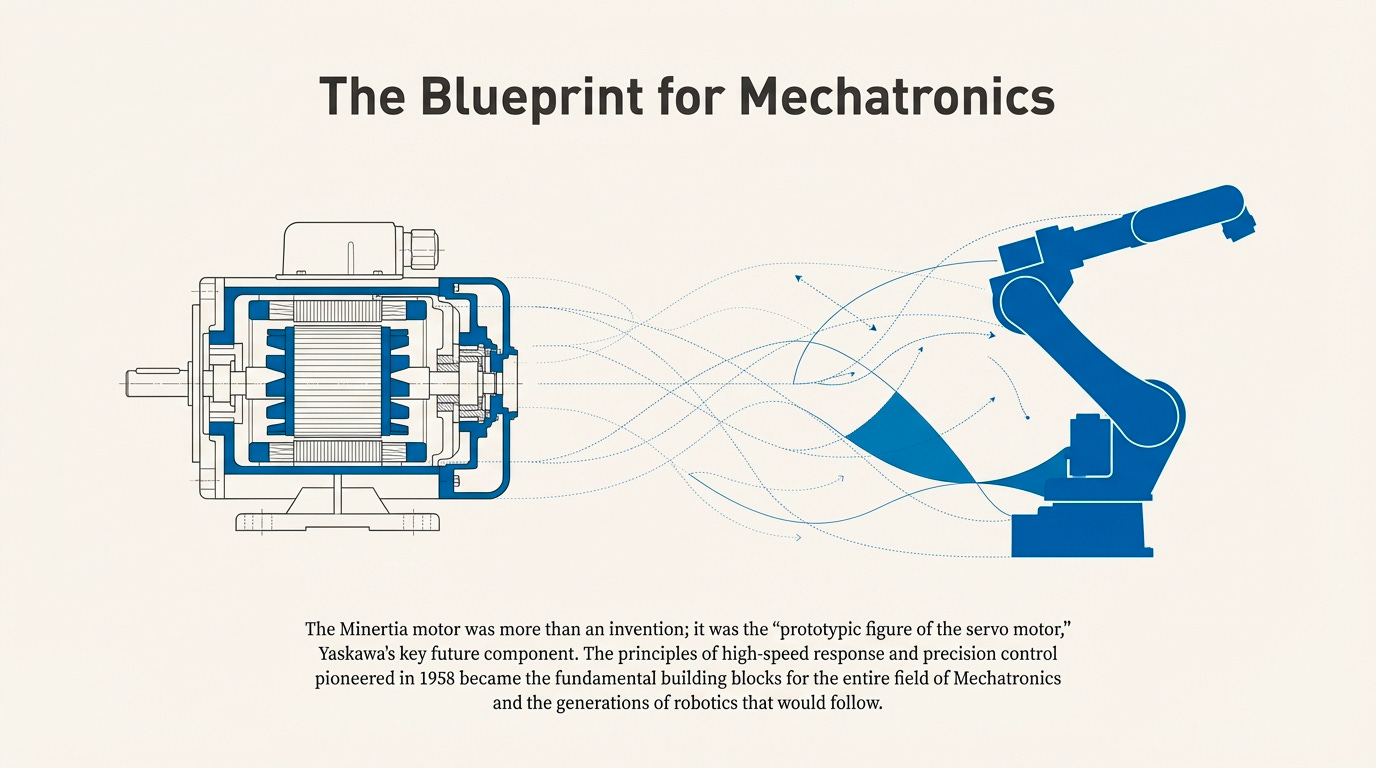
During twenty years, there was a paradigm shift in Yaskwa’s identity : during that period , the company moved beyond standalone components to systems integration and began to define their new concept. Yaskawa proposed the concept of “Mechatronics” in 1969—a term it trademarked in 1972. This doctrine aimed to integrate customer machinery with Yaskawa’s electronic controls to achieve higher functionality.
The unmanned factory concept is not a new concept, it was founded long before and they believed that the trinity of combining a detector, controller and actuator would help to build more unmanned factory.
About robotics, their philosophy shows a lot of improvement and the commercialization of MOTO arms and fingers in the 1960s formed the basis of a new future at that time. In 1977, Yaskawa launched the MOTOMAN-L10, Japan’s first all-electric industrial robot, which became the basis for its current robotics division. Concurrently, Yaskawa revolutionized drive technology with the world’s first transistor AC drive in 1974. Moreover, the company cemented their reputation by winning Deming Prize in 1984 and integrated Quality First into their corporate DNA.
Globalization and digitalization : 1990s – 2010s
Entering the late 20th century , Yaskawa engaged their global expansion and began their production in the US in 1992 followed by an establishment of Yaskawa China Robotics in 2012 as its first overseas robot production base.
Technological Milestones:
· 1992: Launch of the Σ (Sigma) series AC servo drives, which became a cornerstone of the motion control business due to their miniaturization and high performance.
· 2003: Networked the MECHATROLINK system to facilitate seamless communication between motion control devices.
· 2015: Celebrated its 100th anniversary, establishing a “Robot Village” at its head office to symbolize its commitment to the next century of innovation.
The “i3-Mechatronics” Era (2017–Present)
In 2017, Yaskawa evolved its founding doctrine into a new solution concept: i3-Mechatronics (integrated, intelligent, innovative). This strategy added “digital data management” to the traditional automation model aiming to realize the “unmanned factory” envisioned decades earlier using large amount of data. This concept moves beyond simple automation to creating “cells” where robots and servos are integrated and managed via data to enable autonomous process improvements. Operational since 2018, the Yaskawa solution factory serves as a demonstration plant for this concept. Now, with an advanced AI Yaskawa realized in 2023 the first launch of MOTOMAN NEXT series : an autonomous robot capable of making judgements and adapting to unstructured environments which markets a big shift from simple repetition to intelligent action.
What about their vision in 2026 ?
A massive investment of 180 million a new campus in the United States to consolidate production and reinforce their research and development proves that their solid commitment to continue to develop technological innovation. But what about their DNA values ?
Yaskawa’s 110-year history is characterized by Six DNAs that define its culture:
Technology-driven: A commitment to world-first innovations.
Customer focus: Providing optimal systems based on application needs.
Quality first: A standard established during the heavy industry era.
Mechatronics: The proprietary concept of integrating mechanism and electronics.
Policy-based management: Organizational alignment tools adopted alongside TQC.
Global: Localized business operations adapted to regional characteristics
Let’s dig deeper about their new concept of icube mechatronics and see that it’s contributing to society by focusing on customers needs while promoting productivity at its highest level and physical AI could actually revolutionize their impact. I believe that new advances in AI could unlock a new frontier for industrial robots and unravel intelligent systems.
New Vision : i3 mechatronics
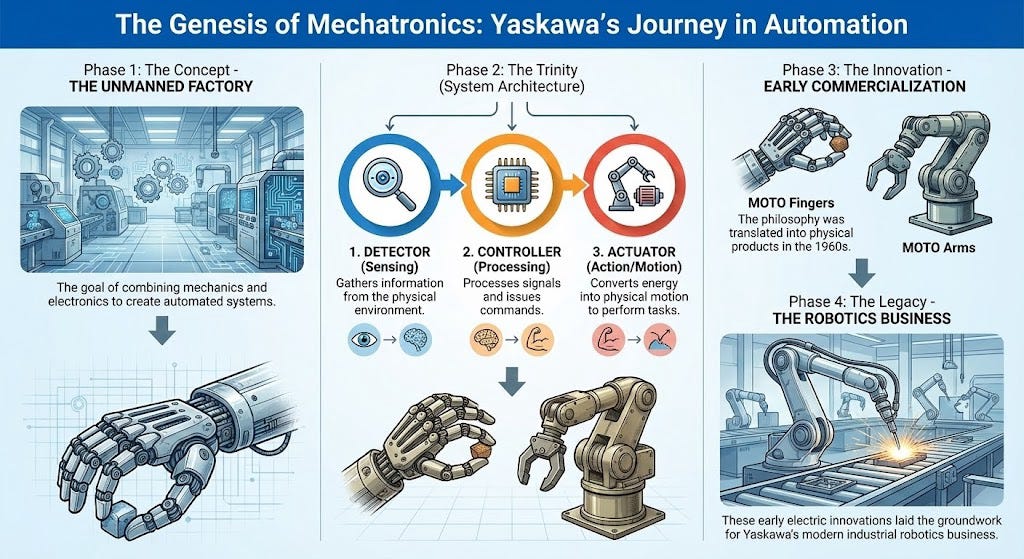
Their vision of i-cube mechatronics was possible before AI, they explain that the original concept of mechatronics was created with the intent to drive a third industrial revolution in the 1970s. Let’s get back to their origin and trinity concept, Yaskawa explicitly claims ownership of the concept’s origin. They coined the word “MECHATRONICS” and registered it as a trademark in 1972.
The foundational doctrine was established in the 1960s and was based on the concept of unmanned factory. It was the first time that a company views automation as a possible competitive advantage, and they were not wrong. Long before AI was discovered, their approached viewed automation as a trinity combining three distinct elements into one system:
a. Detector (Sensing)
b. Controller (Processing)
c. Actuator in other terms, a machine component that converts different type of energy into physical motion.
The commencement of industrial revolution began with small innovation: ironmaking with the substitution of coke for charcoal, steam power which underwent a rapid expansion and the invention of other machine tools that expanded our vision of industrial production. Yaskawa has the same vision, they believe that a new industrial automation revolution is possible, and they are betting on a future where industry 4.0 will be a key to be more productive. Competitiveness and rapid expansion are key themes aborded by the company, standards applied to their new concept and their triptych is composed of 3 main core values:
1. Integrated: They promote the use of automation of cells; in other terms a robotic cell is an environment that integrates one or two robots with different additional devices such as sensors and their primary function is to produce a work with a minimal human intervention monitored by control systems. Now, the concept of automation of cell means that the robots will work autonomously to perform manufacturing task like assembly, welding, or material handling and they want to create self-contained automated workstations. Those works stations will include their products: industrial robots, servo motors and AC drives. They also include a new data collection system that give me another advantage.
2. Intelligent: Once the data are collected from production field, they are digitalized and the use of data digitalized are being used to render these data as intelligent.
3. Innovative: After the data collection, production innovation appears and we begin to operate at higher speed, precise cooperation between the different robots and synchronous control between the different equipment. The idea is that data are fed back to operations, and the system operates autonomously.
Conservative Strength, Radical Innovation: Yaskawa’s Leadership as the Platform for Physical AI
The transition from traditional automation developed in the sixties to a new form of intelligence is unfolding progressively with the development of AI. Models are becoming more complex and efficient which ultimately lead to the development of a new way of automation called Physical AI. Physical AI refers to a branch of artificial intelligence that enables machines to perceive, understand, reason, and interact with the physical world in real-time, rather than existing solely in the digital realm. In other words, Physical AI givesmachine a brain and a body to understand and interact with the physical world. Hence , we have to understand that the transition requires a robust operational framework and Yaskawa’s i³-Mechatronics provides exactly this promise by connecting executive management issues to the factory floor. Designed to solve client challenges through the integration of data and mechatronics, the concept moves beyond efficiency to offer a layered automation strategy essential for intelligent systems. As physical AI systems requires a blend of rule-based precision and context-based adaptability , the concept of i3-mechatronics approach connects servo motors, robots and digital centers to create necessary infrastructure for these advanced AI applications. The synergy empowers companies to maximize productivity by turning raw operational data into actionable, AI-driven business value and intelligence for robotics through the process of trial and error as mentioned before.
Physical AI : a new frontier of innovation for a better productivity.
As explained previously, Physical AI represents a new era of industrial automation defined by the convergence of advanced hardware, artificial intelligence (AI), and vision systems. Unlike traditional robots that repeat pre-programmed programs, Physical AI enables robotic systems to perceive, reason and act which is a profound change in the industrial robotics and could unravel a lot of opportunities for several sectors ranging from agriculture to automotive.
As a matter of fact, physical AI serves as a bridge between the digital world (algorithms/data) and the physical world (motors/grippers) allowing machines to handle tasks that were previously too complex or variable to automate. You maybe wondering what are the capabilities of the physical AI , indeed we are far from the imagination of people of robots driving cars or thinking like human beings. On the contrary , industrial robotics remains a complex science that needs time to be developed but we know that Physical AI can grant three core capabilities to robots that mirrors human interaction. Those three core capabilities , i call them the intelligent trinity and they can be listed as follows :
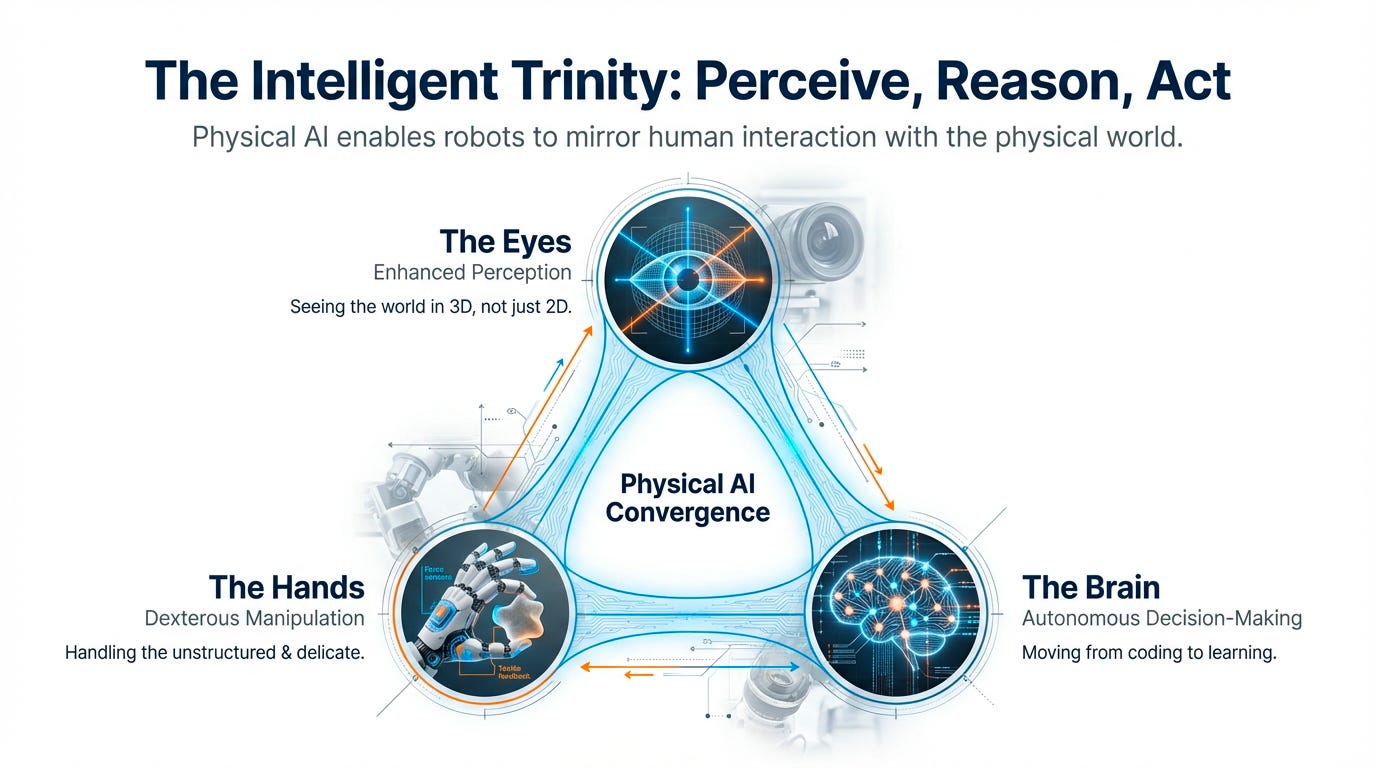
1. Enhanced Perception (The Eyes & Senses)
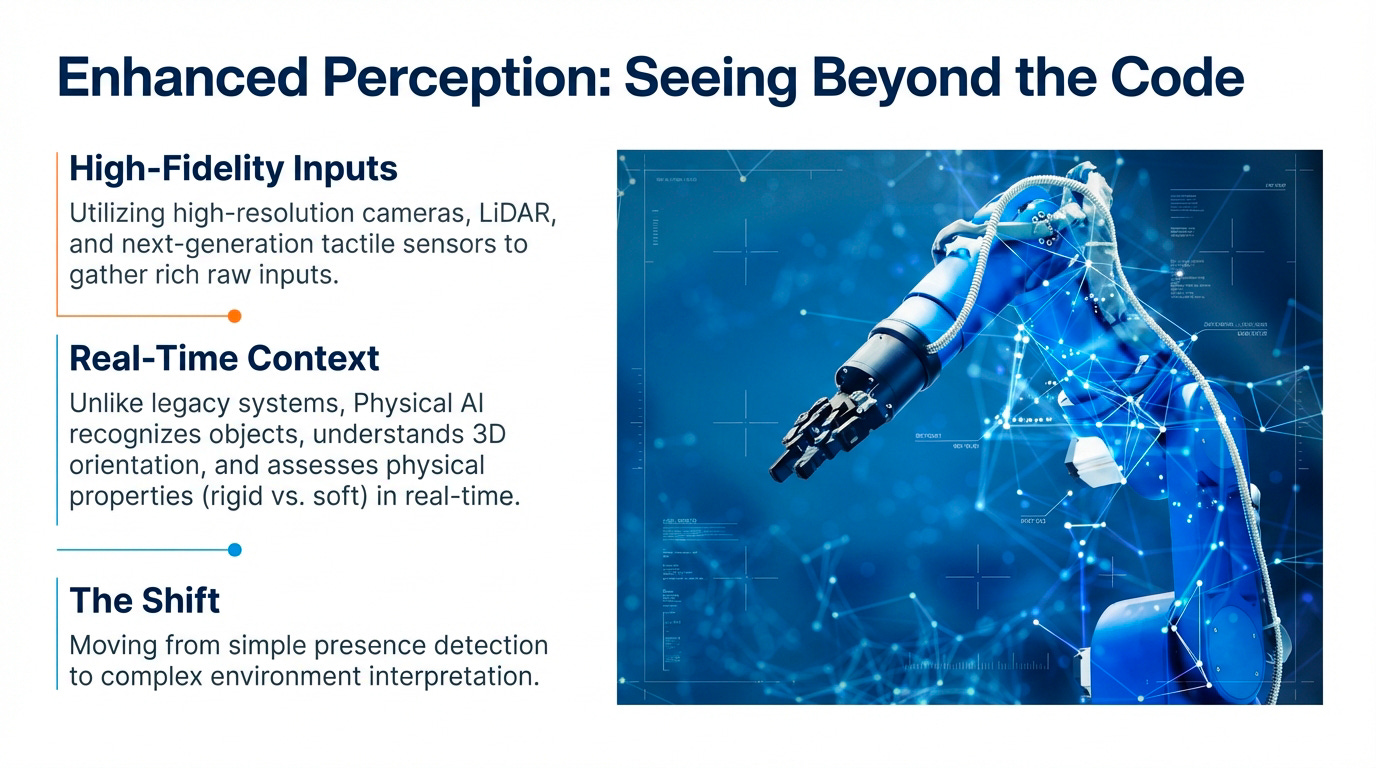
• Seeing the World: Using high-resolution cameras, LiDAR, and tactile sensors, robots can now recognize objects, understand their 3D orientation, and assess physical properties in real-time.
• Context Awareness: Robots can identify irregular or delicate items and interpret complex, unstructured environments.
2. Autonomous Decision-Making (The Brain)
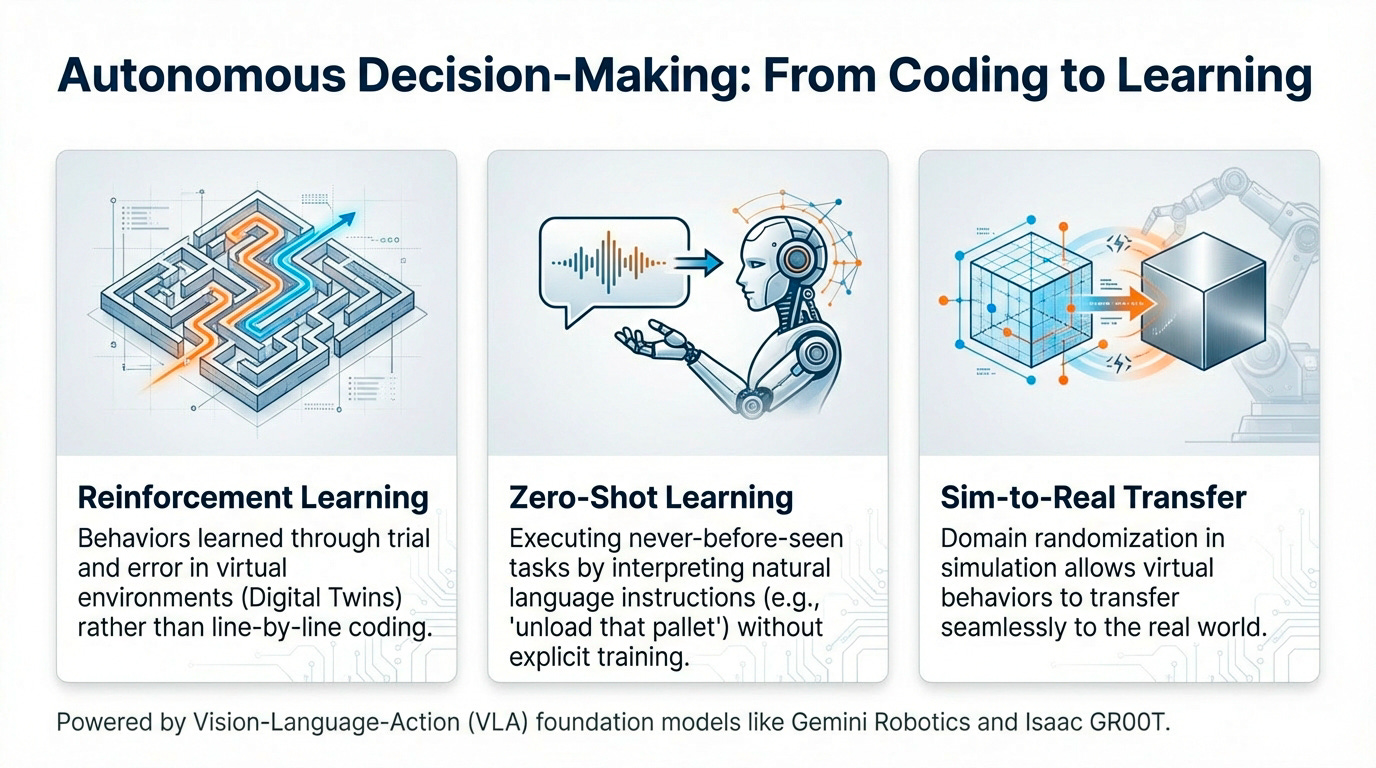
• From Coding to Learning: Instead of rigid, line-by-line coding, robots use Reinforcement Learning and Simulation to learn behaviors through trial and error in virtual environments (Digital Twins).
• Zero-Shot Learning: Advanced systems can execute tasks they have never seen before (”zero-shot”) by interpreting natural language instructions (e.g., “unload that pallet”) without explicit training.
3. Dexterous Manipulation (The Hands)
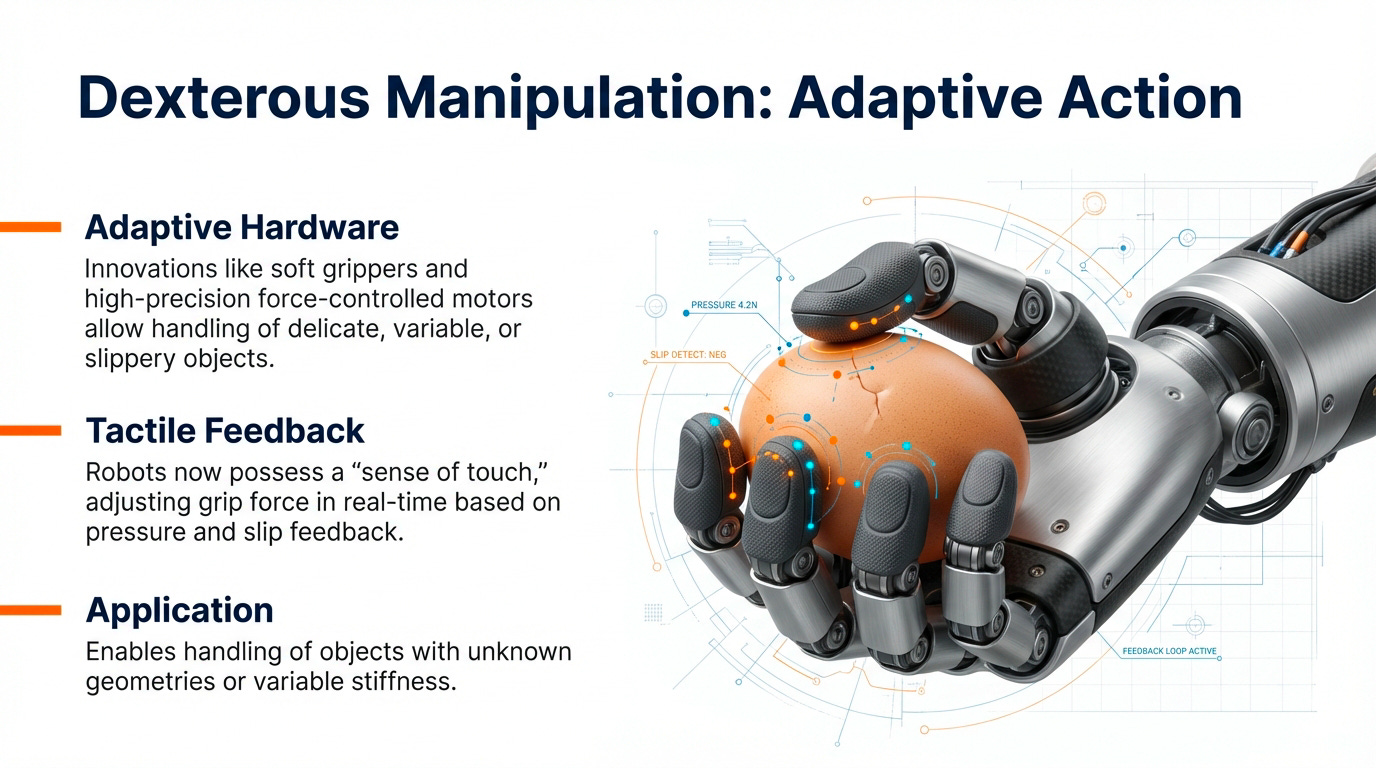
• Adaptive Action: Robots can adjust their grip force and motion in real-time.
• Advanced Hardware: Innovations like soft grippers and high-precision force-controlled motors allow robots to handle delicate, variable, or slippery objects that traditional robots would crush or drop.
Now , we have to go further by explaining the three types of levels of robotics that we can encounter in the industry right now :
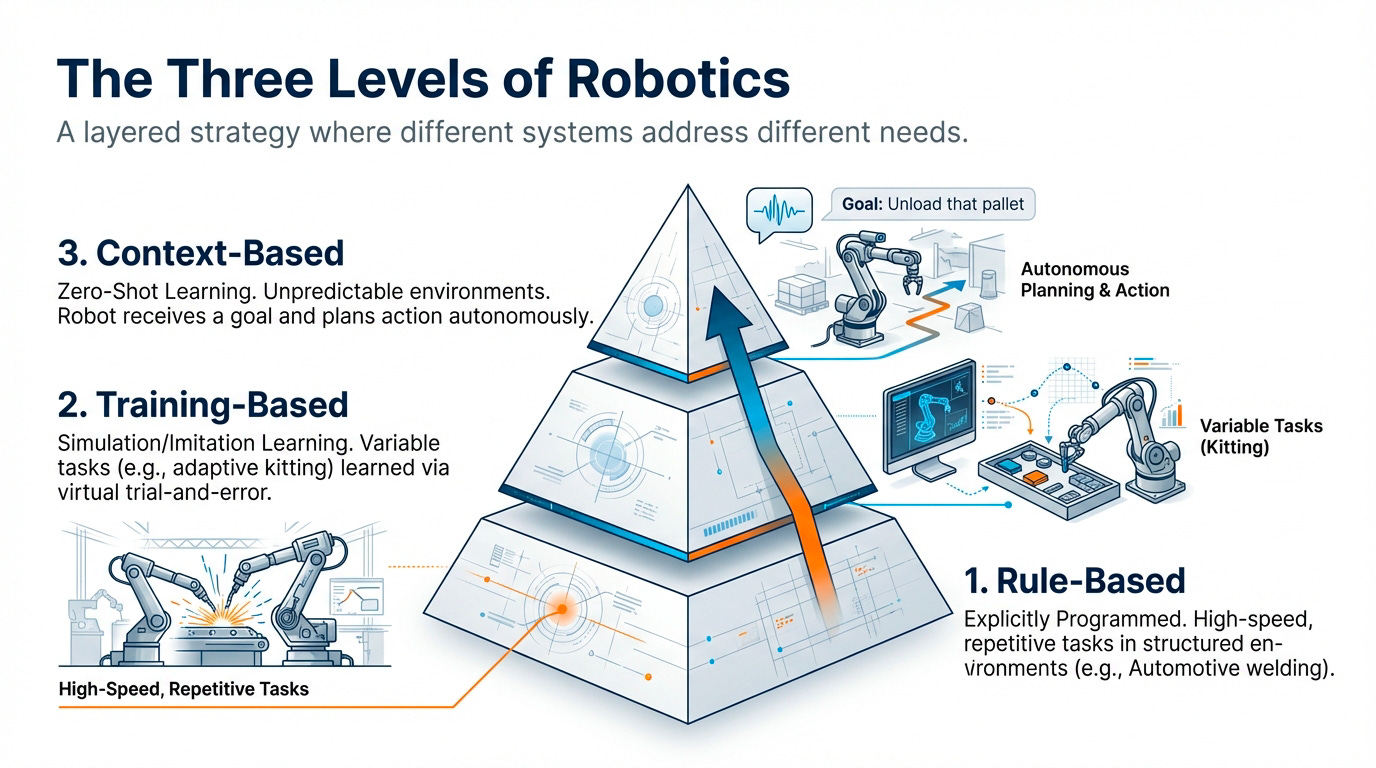
Rule-based : High-speed, repetitive tasks in structured environments (e.g., Automotive welding). To do it, we have to explicitly program the process so that the robots will act as we want.
Training-based : With simulation , imitation learning we can perform ariable tasks like "adaptive kitting" where the robot learns from virtual trial-and-error.
Context-based : Highest level of robotics, The robot receives a goal and plans the action itself (e.g., Logistics in a changing warehouse) and can operate in unpredictable environments which is of paramount importance in sector where we have to produce constantly 24 hours.
"The next big thing is Physical AI, AI with a body. Robots, autonomous machines, industrial systems... It's all coming." Nvidia CEO Jensen Huang
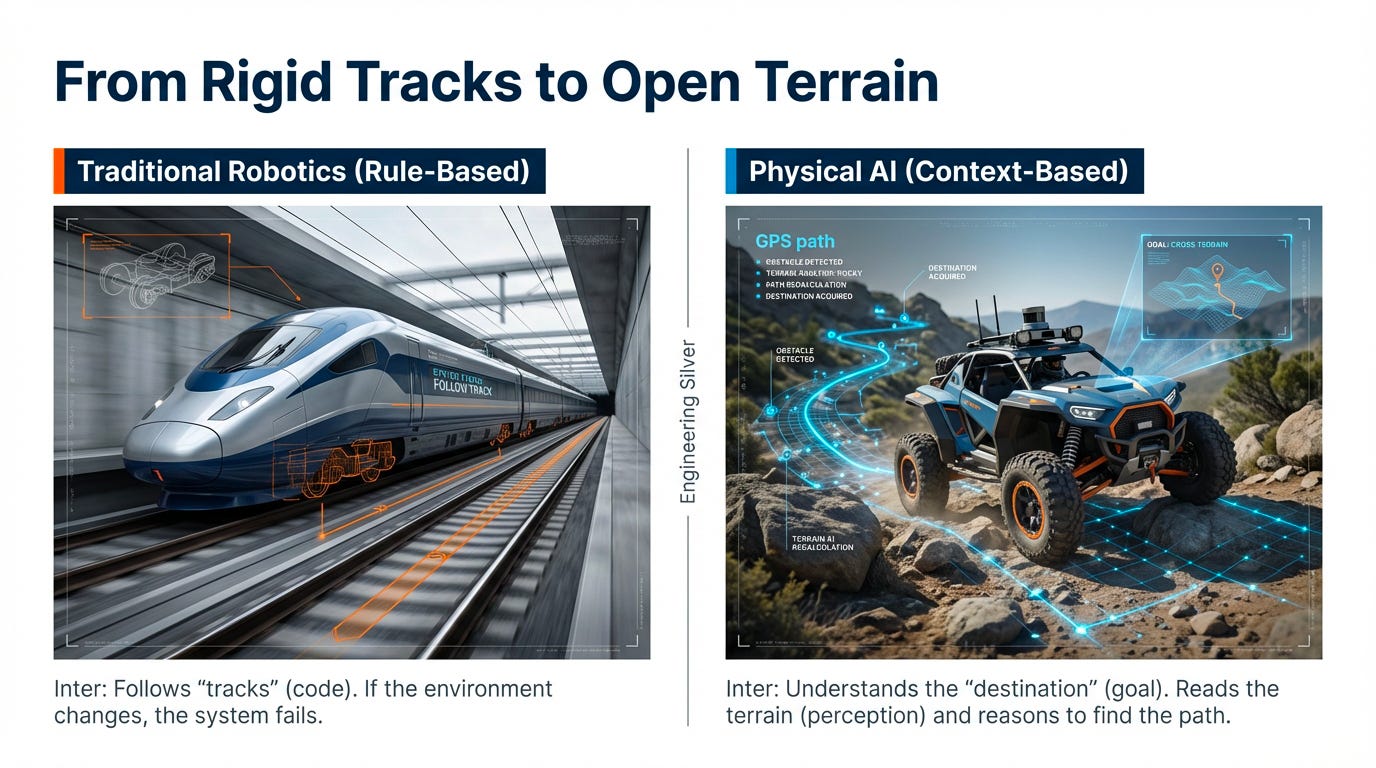
Why it matters ? Because we can now understand that our industrial is experiencing a big revolution , but at what costs ? Less people unemployed that don’t consume is a loss of aggregate demand for the economy where consumer demand is the largest component of GDP. With robots that can understand the destination , read their order and reason to find the path to a higher productivity , their task to mirror our actions could definitely be a significant threat for our economy. Nevertheless, we should rethink our entire industry , industrial robots are being a large part of this rethinking and we have to understand that there is a strategic selection that must appears in the operating field of our factories : Matching system to task
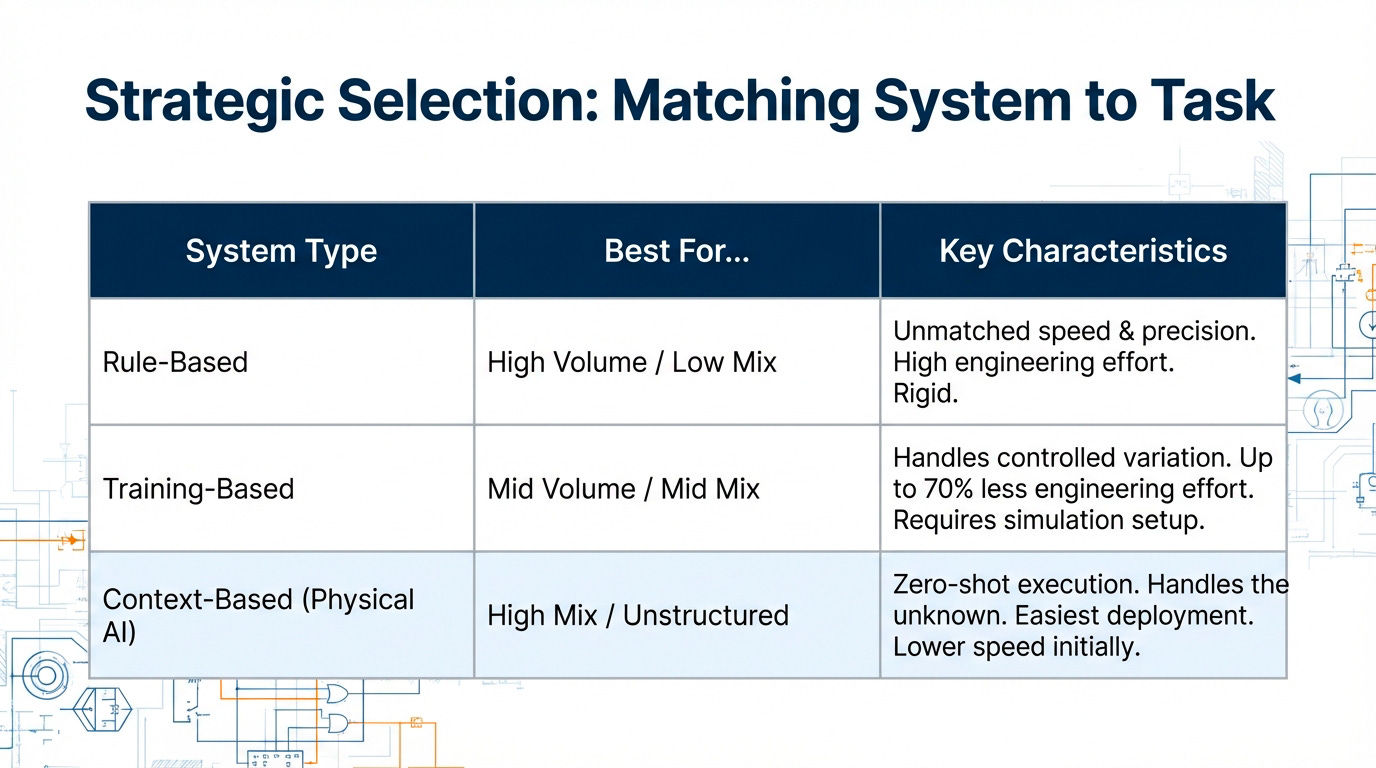
Each of the key characteristics of the system type has been listed above have different purposes , for rule-based for instance we know that in an automotive plant especially the automotive Body Shops (Welding) high volume is required to produce at a faster pace than competitors. In an automotive plant, the car body is in the exact same position every time. The robot follows a deterministic path to weld specific points with unmatched speed and precision but if the car model changes the production line must be stopped and the robots reprogrammed which is expensive and time-consuming.
For training-based , the environment is different and it is best for high-volume tasks with variations or high precision requirements that are difficult to code manually.
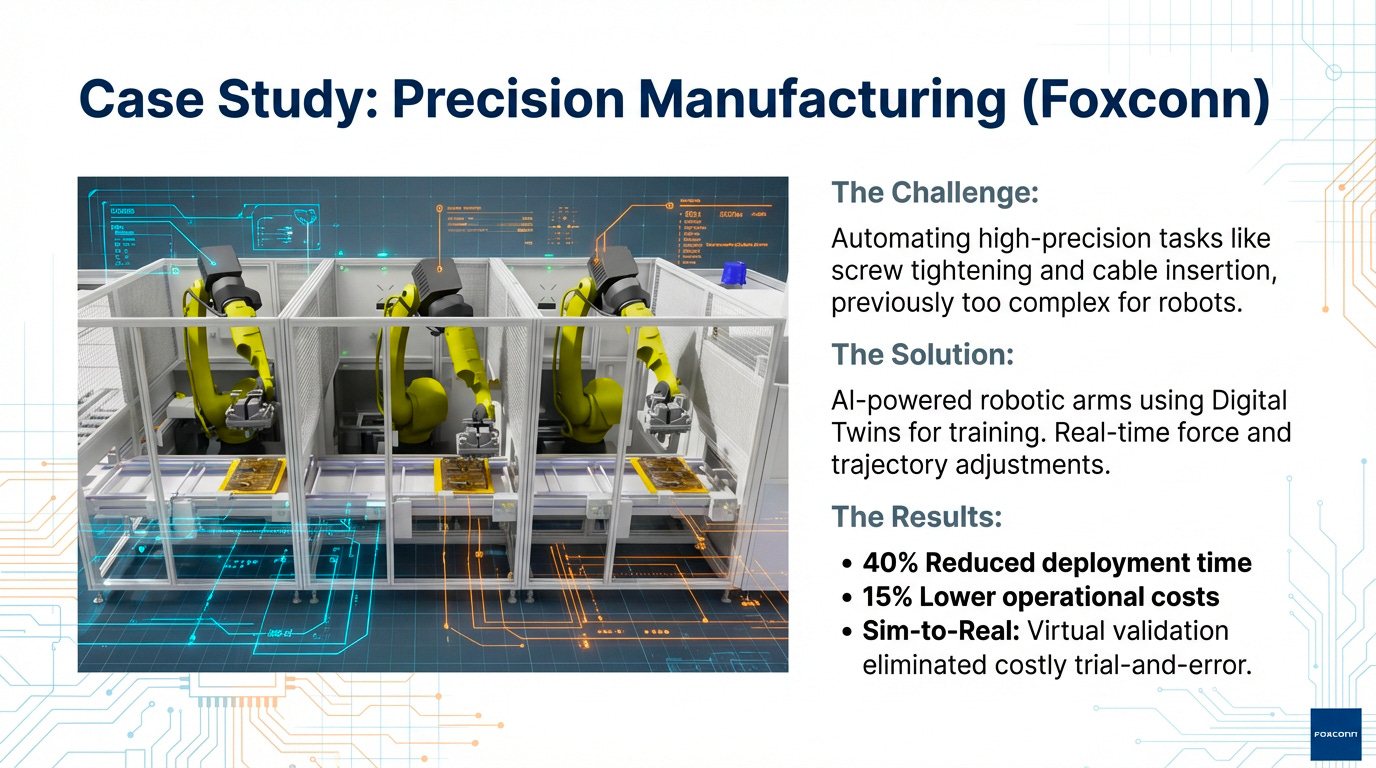
Example : Electronics manufacturing (Foxconn) , Foxconn a major electronics manufacturer uses AI-powered robotic arms for precision tasks like screw tightening and cable insertion. These tasks require “real-time force and trajectory adjustments” to accommodate slight variations in parts. Through reinforcement learning in a digital twin (simulation), the robots learned optimal motion trajectories to insert cables and tighten screws faster and more reliably than humans.
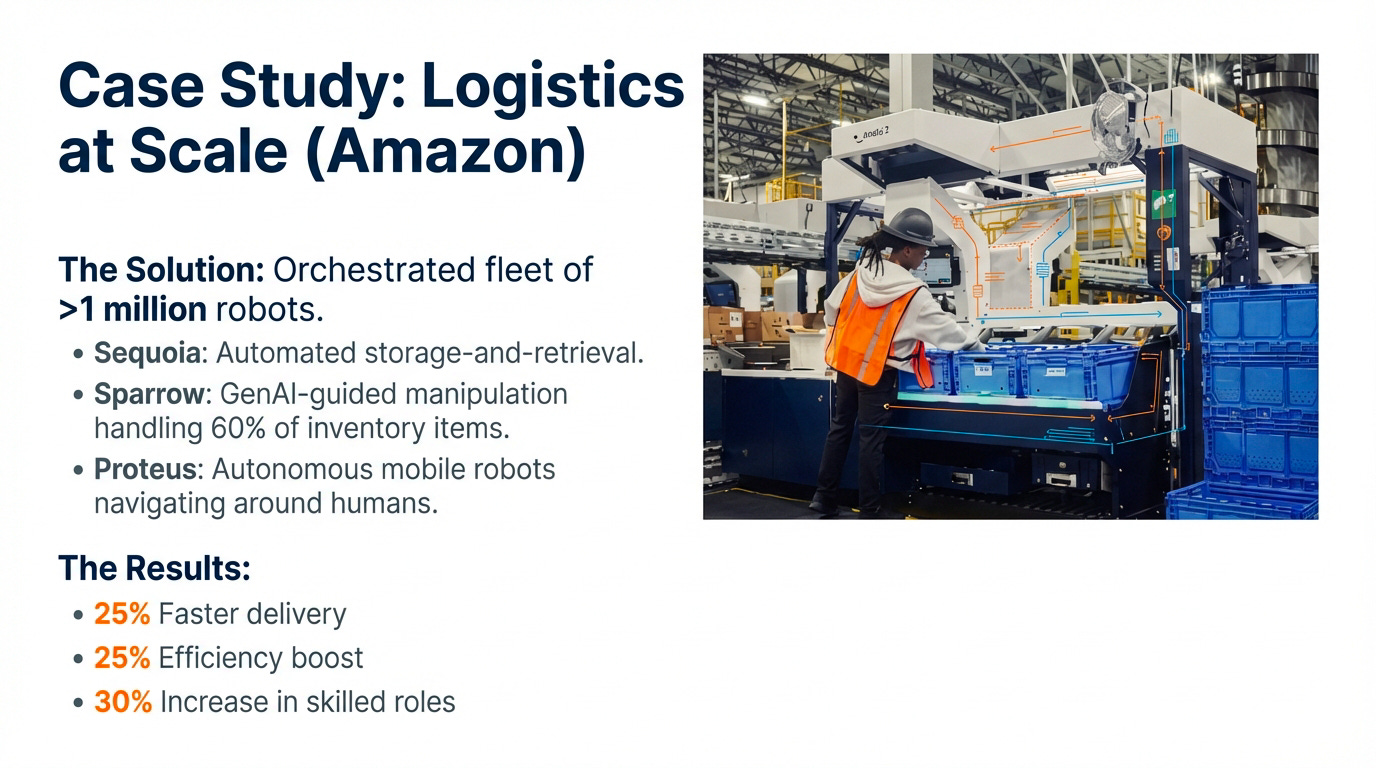
For context-based rules , high-volume is privileged and for environment that changes constantly. Traditional robots cannot handle this because the shape and position of items in a bin are unpredictable (unstructured). Context-based robots "perceive" the jumbled bin "reason" the best way to grab an item and "act" to pick it up , Yaskawa is deploying MOTOMAN NEXT for similar unstructured high-volume tasks, such as handling variable food products (e.g., removing cucumber leaves) or organizing logistics where the robot must judge how to handle "unstable materials" that vary in shape and size.
But theory and vision doesn't pay shareholders so next week, we will open our eyes on Yaskawa’s financials to see exactly how their Motion Control, Robotics, and System Engineering segments are turning this innovative and costly robotics into currencies.
Sources : WEF - Physical AI: Powering the New Age of Industrial Operations
Yaskawa Annual Report 2024